Why Is Costco's P/E Ratio So High?
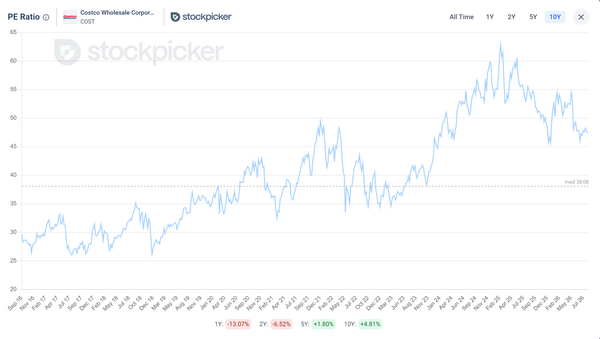
Costco stock trades at about 47 times earnings while the retail-defensive industry median sits near 17.
Costco's P/E ratio is so high because the business has a long track record of operational excellence, and investors expect that record to hold. Costco's business model is quite different from other retailers'. Most of the profit comes from paid memberships, which lets Costco cut its retail margins and offer competitive prices. It is a self-sustaining engine, because lower prices attract more members, and the size of the membership base gives Costco leverage when it negotiates with suppliers.
Why did Costco's P/E ratio go up?
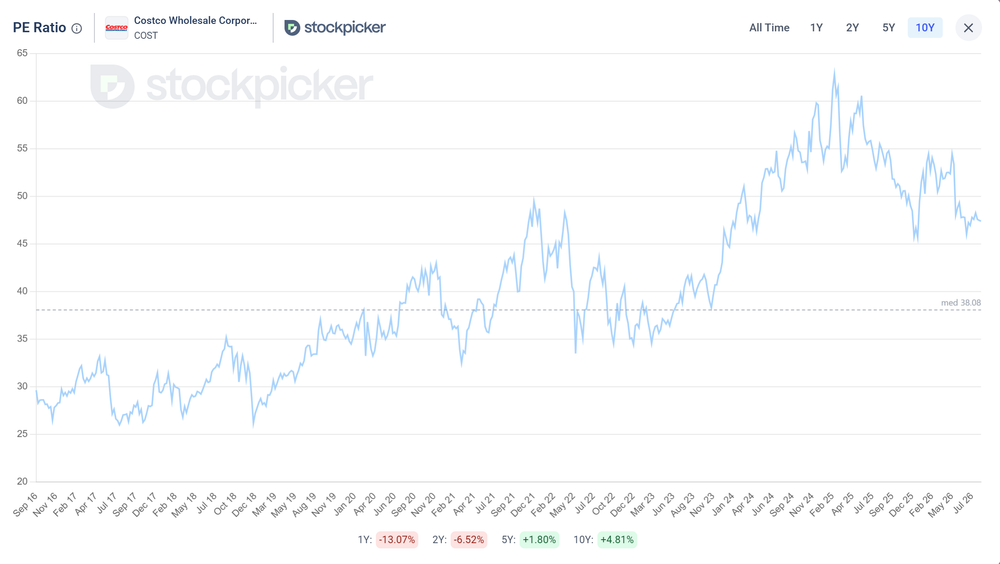
Costco sat around 30 times earnings through most of 2022 and 2023, then re-rated through 2024 into early 2025. Here are the main reasons the multiple expanded from around 30x to around 47x today.
- Costco is considered a defensive stock that holds up well in recessions. When the economy looks uncertain, people shop at Costco even more, because the low prices matter more when money is tight.
- Passive money keeps flowing in. Costco is one of the largest companies in the S&P 500, so every dollar that goes into an S&P 500 index fund buys some COST automatically, regardless of price.
- Costco is an obvious non-AI play. Investors who want a solid, growing company without AI exposure are willing to pay a premium for it.
How Costco makes its money
Costco sells merchandise at very low margins on purpose. Low prices are what keep members renewing, so the company gives up profit on the shelf to protect the renewal.
The money comes back through the fee. A member pays $65 or $130 a year, Costco spends almost nothing to collect it, and most of it goes straight into operating income. Around 90% of members renew, so that income shows up again the next year without the company having to win the customer back.
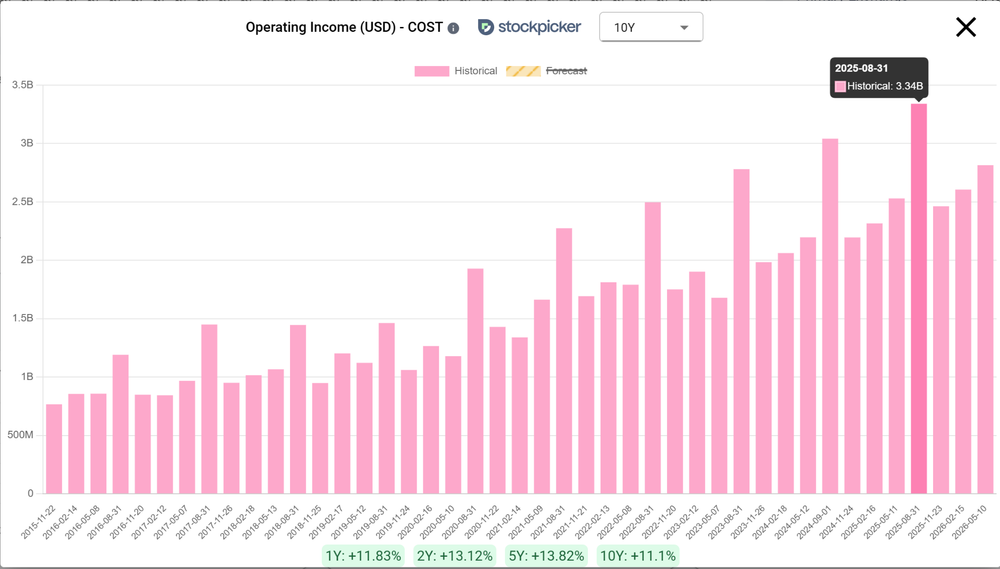
Operating income has grown 13.82% a year over five years and 11.1% over ten.
What is a normal P/E ratio for Costco?
Costco's 10 year median P/E is 38x and the reading above 62 in early 2025 was the highest in its modern history. At 47 today, Costco trades about 23% above its 10 year median.
Is Costco overvalued at 47 times earnings?
A P/E ratio tells you what investors are currently willing to pay for a dollar of earnings. It moves with how confident they feel about the next few years rather than with anything the company reported last quarter.
At 47 times earnings Costco is expensive for the business as it stands. Operating income grows at low double digits, and a multiple in the forties usually sits on faster growth than that.
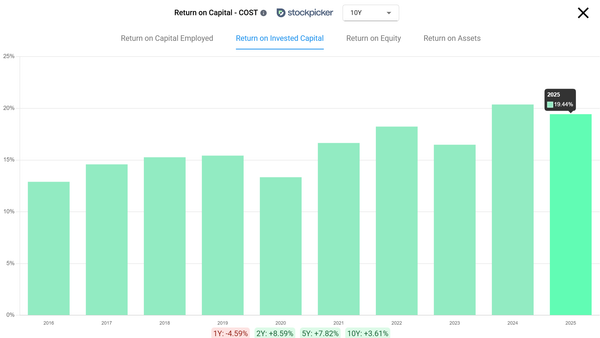
What that comparison leaves out is the quality of the earnings underneath. Costco turns capital into profit efficiently. Return on invested capital grew from 13% to 20% in the last ten years. It has kept growing through inflation and through the pandemic.
Investors are willing to pay higher multiples for a company that performs well in economic downturns. Costco has not traded at an ordinary retail multiple at any point in the past decade.
There is also room left to grow. Costco keeps opening warehouses outside the United States, so the growth investors are paying for does not depend on squeezing more out of the existing base.
Free cash flow yield reads the same way. Costco yields 2.1% today against a ten year median of 2.91%.
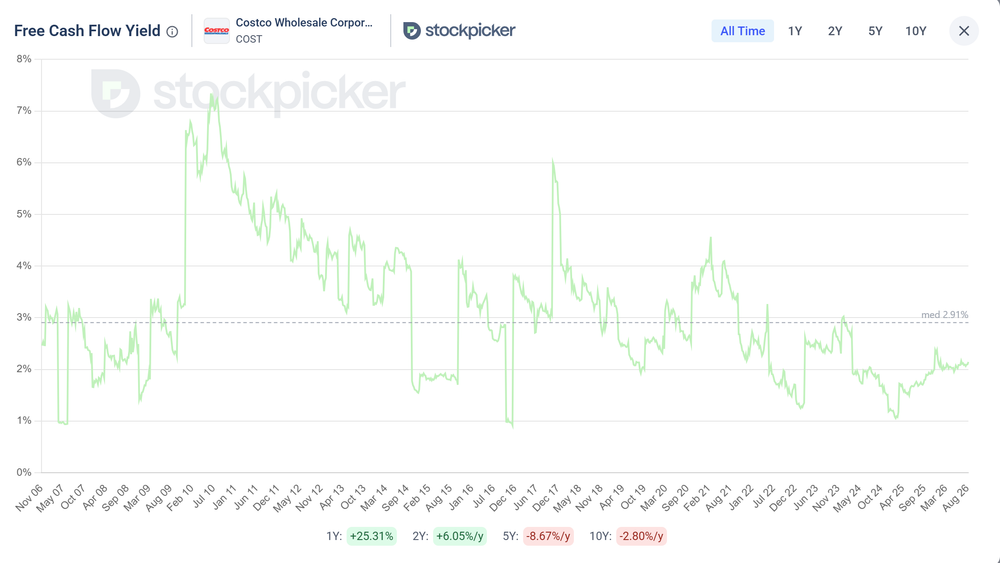
So whether Costco is overvalued depends on what number you anchor to. Against the 5 year median, it looks expensive on both P/E and FCF yield. But investors who focus on the quality of the business and hold for the long term have usually been willing to pay more for that consistency.
What to check on Costco's fundamentals page
Four metrics to check on Stockpicker:
Revenue growth. Everything starts here. A premium multiple only makes sense if the company is selling more each year, and Costco has two ways to do that: more members walking into existing warehouses, and new warehouses opening. If revenue stalls, nothing below it matters.
Operating margin. Revenue is only useful if the company keeps a growing share of it as profit. Watch the margin year over year. Holding or widening means Costco is getting more efficient as it grows. Slipping would be the first sign the model is under strain.
Return on invested capital. How much profit Costco makes on every dollar it puts to work. This is the number behind the premium, and most people skip it because the name sounds complicated.
Free cash flow growth. If cash generation grows faster than the share price, the multiple comes down on its own over time.
You can run all four on the Costco fundamentals page in a couple of minutes.
I wrote about the opposite situation, a high quality business trading at a low multiple, in why Google's P/E is so low. Same question from the other end.
Full disclosure: I have been long COST since 2023. I am not a professional analyst and this is not investment advice. Everything above is my own research and I might be missing something. Do your own work before buying or selling anything.