Stockpicker — Up to 40 Years of Stock Fundamentals
| Company | Market Cap | Yearly Revenue Growth | Price |
|---|---|---|---|
|
NVDA
NVIDIA Corporation
|
5.23T |
+65.47% | $217.09 |
|
AAPL
Apple Inc.
|
5.00T |
+6.43% | $342.94 |
|
GOOGL
Alphabet Inc.
|
4.19T |
+15.09% | $344.18 |
|
MSFT
Microsoft Corporation
|
3.96T |
+17.79% | $533.52 |
|
AMZN
Amazon.com, Inc.
|
2.83T |
+12.38% | $262.45 |
|
SPCX
Space Exploration Technologies Corp.
|
2.56T |
+33.24% | $147.96 |
|
TSM
Taiwan Semiconductor Manufacturing Company Limited
|
2.18T |
+31.95% | $420.22 |
|
META
Meta Platforms, Inc.
|
1.80T |
+22.17% | $705.44 |
|
2222.SR
Saudi Arabian Oil Company
|
6.24T |
-9.02% | SAR 25.80 |
|
AVGO
Broadcom Inc.
|
1.60T |
+23.87% | $334.59 |
Video Analysis
View all

Our analysis
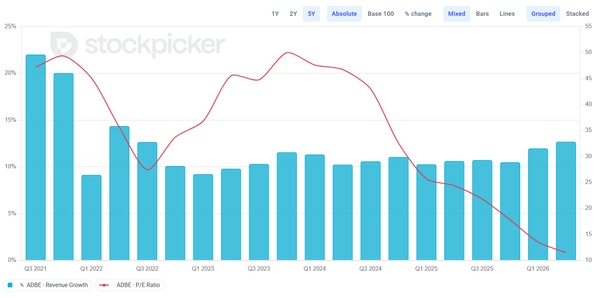
What Is a Good P/E Ratio?
A good P/E depends on how fast the company is growing, how reliable its earnings are, and how its own multiple has behaved in the past. A P/E of 10 can be expensive and a P/E of 40 can be reasonable, depending on the business underneath it. The P/E ratio is generally affected, positively or negatively, by two important factors: * Business growth: a higher growth profile commands a premium. If you have two businesses with similar earnings, but one is growing profits 5% while the other is growi
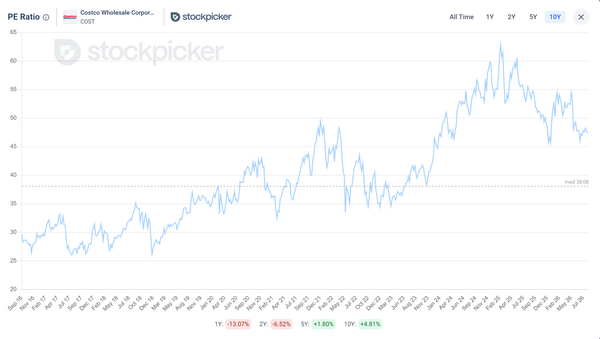
Why Is Costco's P/E Ratio So High?
Costco stock trades at about 47 times earnings while the retail-defensive industry median sits near 17. Costco's P/E ratio is so high because the business has a long track record of operational excellence, and investors expect that record to hold. Costco's business model is quite different from other retailers'. Most…

Fiscal.ai Review 2026: Pricing, Features & Alternative
Fiscal.ai is one of the most capable research platforms available to investors today. It pulls earnings call transcripts, segment-level KPIs, analyst estimates, filings and an AI assistant into one place, runs on institutional data, and covers over 100,000 companies globally. It does things most research products do…
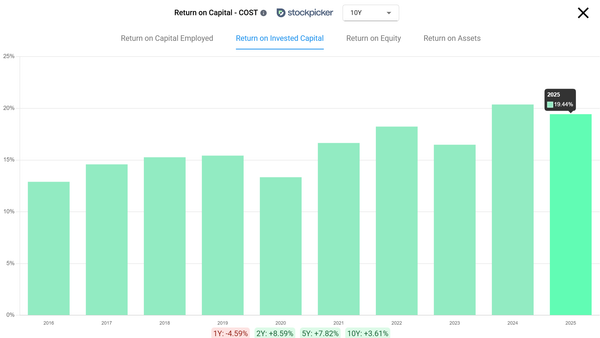
What Is a Good ROIC for a Company?
TL;DR * A good ROIC is above 12%. Above 15% is considered strong. * What counts as good depends on the cost of capital. Most large companies pay 8% to 12%, so a 10% return is standing still. * A high return only matters if the company still has somewhere to reinvest. 20% with a runway beats 40% without one. * ROIC…