Meta vs Broadcom, Why Broadcom Is Worth More Than Meta?
Meta and Broadcom have similar market caps, with Broadcom valued around 12% higher at $1.82T against META's $1.63T. A dollar is a dollar, so it is important to know what underlying business you are buying for a similar valuation.
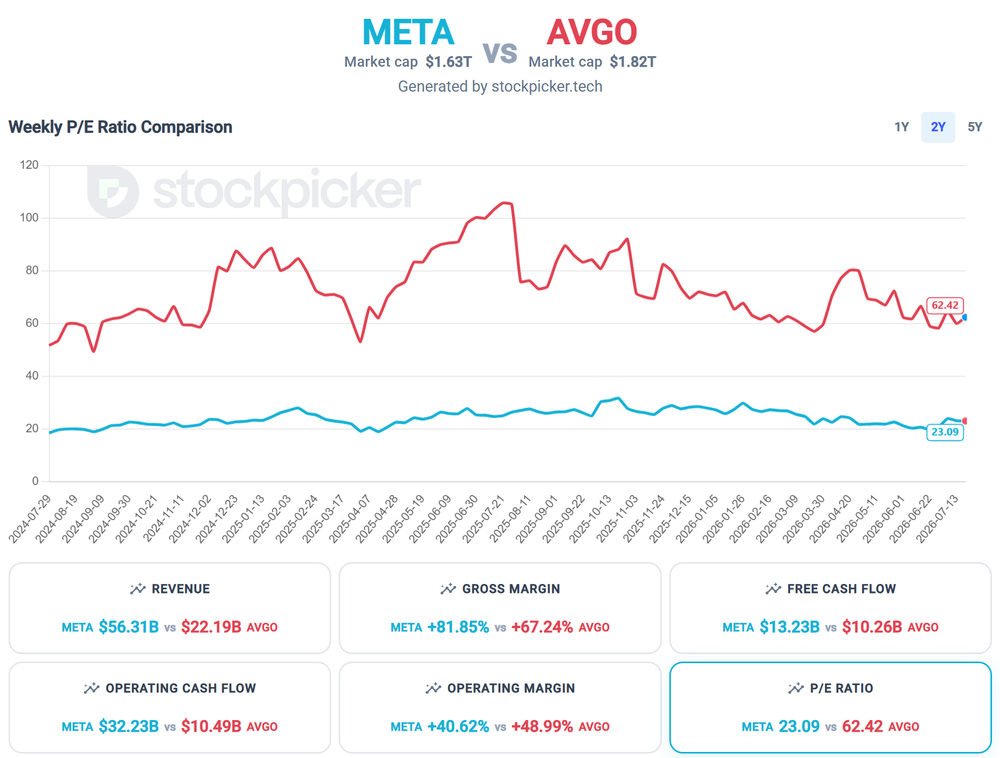
I ran both companies through the Stockpicker Comparison Tool and here are the raw numbers.
Meta generated $56.31B revenue last quarter, more than 150% higher than Broadcom's $22.19B. Meta also generated higher free cash flow, despite the pressure from its capex investments.
Although Broadcom's operating margin is higher, Meta generated 3x the operating cash flow last quarter.
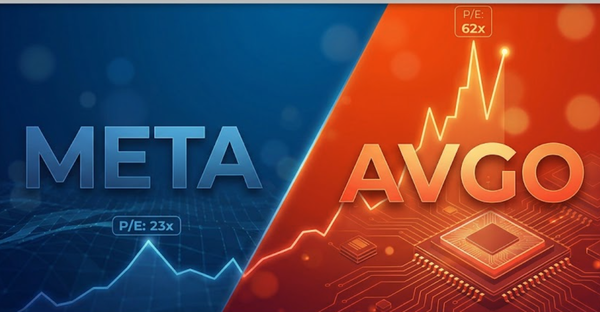
So why are investors ready to pay so much more for Broadcom? Trailing P/E for AVGO is 62x, while for META it is 23x.
What revenue is already priced into Broadcom at 62x?
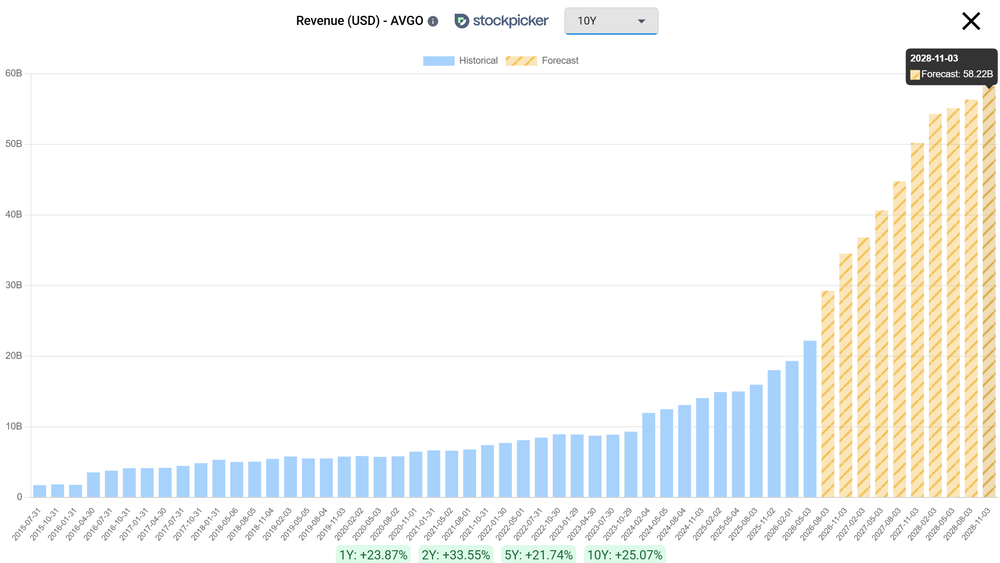
Broadcom benefits from the momentum of AI stocks. The revenue is expected to grow as long as hyperscalers keep spending on capex, media hype keeps lifting those expectations, and analysts now model AVGO revenue reaching $58B per quarter by 2028. That would be roughly 2.6x the $22.19B it just reported, so the market is not paying 62x for the business that exists today. It is paying 62x for the business analysts think exists in two years.
Run that forward and the multiple makes more sense on its own terms. If Broadcom hits $58B a quarter and holds anything close to its current margins, earnings roughly triple, and at today's price the stock would be trading somewhere near Meta's current 23x. The whole premium rests on that number landing.
What does Broadcom do for Meta?
Broadcom designs the custom chips Meta runs its AI on, which makes these two companies far more entangled than a side by side comparison suggests.
In April 2026 the two announced a multi-year partnership running through 2029, covering chip design, packaging and networking. Broadcom builds the technology behind Meta's MTIA chips (Meta Training and Inference Accelerator), including what it calls the industry's first 2nm AI accelerator, and supplies the Ethernet silicon that connects those clusters. The initial commitment is more than 1GW of compute, described by both companies as the first phase of a multi-gigawatt rollout, and Hock Tan said on the March earnings call that the next generation scales to multiple gigawatts in 2027 and beyond.
How big is this for both sides? Hock Tan, Broadcom's CEO, had sat on Meta's board since 2024, and he decided not to stand for reelection. He moved to an advisory role, and both companies pointed to the scale of the expanded partnership as the reason.
So when I say Meta's capex funds Broadcom's growth, that is literal, not a figure of speech. A meaningful share of Meta's $125B to $145B budget lands on Broadcom's income statement as high margin revenue, where the market pays 62x for it. The same dollars show up as a cost on one company's statements and as revenue on the other's, and the market prices them very differently depending on which side they land. I covered where that money is going in my analysis of hyperscaler capex spending.
Why is Meta's P/E only 23x?
If we look at META's revenue, it grows a bit slower, but from a much higher level. Analysts project over $100B in a single quarter in 2028, extending to more than $120B by 2030. Broadcom's projected $58B quarter in 2028 would still be less than 60% of what Meta is expected to do in the same period, so the company investors are paying up for is the smaller one on both current and forecast revenue.
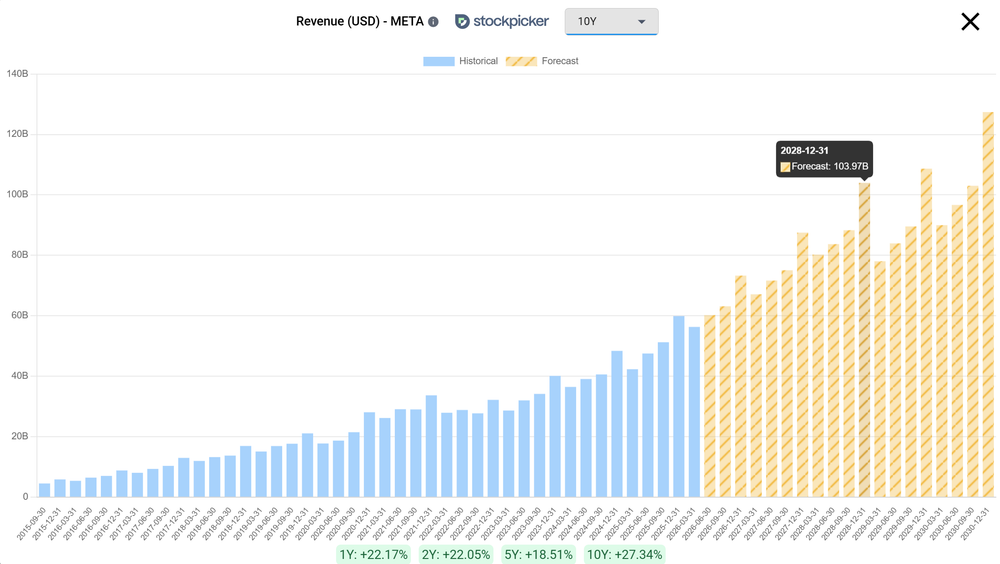
Investors are still willing to pay less for Meta, and the reason is what the business is turning into. Meta is transitioning from a capital light business to a capital intensive one, with capex of $125B to $145B for 2026 and a number that is likely to expand again in 2027. An advertising business that needed almost no physical infrastructure is now buying land, power and silicon at industrial scale. Every dollar of that spending is certain, while the return on it is not, and the market prices certainty and uncertainty differently.
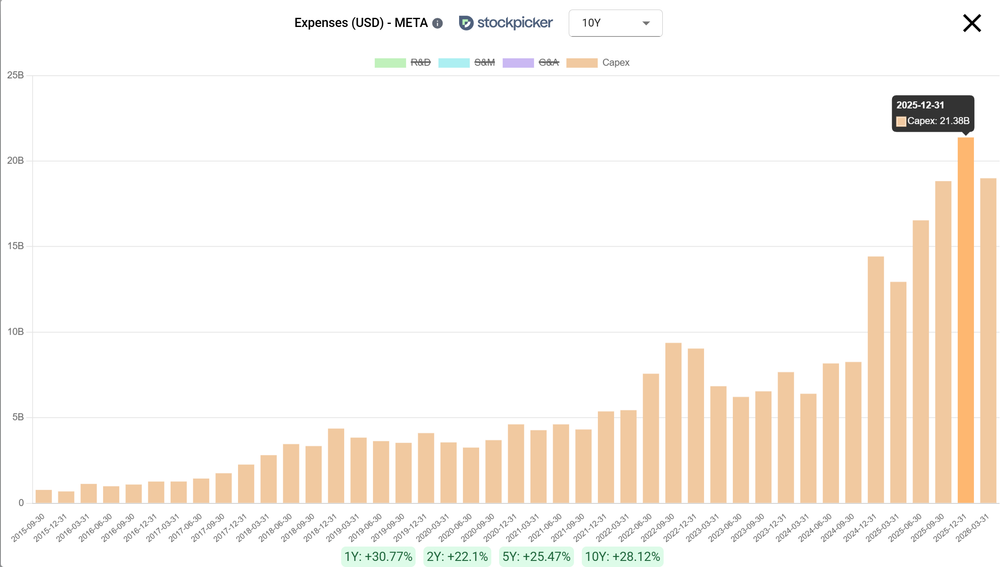
Ironically, META's capex funds Broadcom's growth. The same dollars that compress Meta's free cash flow and weigh on its multiple show up as high margin revenue on Broadcom's income statement, where the market pays 62x for them. Both companies are being valued off the same pile of money, just at opposite ends of it.
But what happens if hyperscalers start scaling down their spending?
Broadcom has confirmed six major custom chip customers. Google is the oldest, co-designing TPUs since 2014 across seven generations. Meta, ByteDance, OpenAI, Anthropic and Fujitsu make up the rest. The unnamed $10B customer that moved the stock through 2025 turned out to be Anthropic, confirmed in December of that year.
That is the customer base. Meta, Alphabet, Amazon and Microsoft are not obligated to keep raising capex forever. They will keep spending as long as the return justifies it, and the moment it doesn't, capex is one of the fastest lines on the income statement to cut. Where would companies like Broadcom fund their growth from then? Would they even continue growing?
In fairness to the other side of this, the Meta agreement runs through 2029, so part of that revenue is contracted rather than hoped for. Multi-year commitments from Google, OpenAI and Anthropic work the same way. Contracts are not immune to renegotiation when budgets tighten, but they are not the same as a customer who can walk away next quarter either.
That is still the asymmetry between the two. Meta controls its own capex and can cut it if the returns disappoint, which would hurt the growth story but immediately restore the free cash flow. Broadcom does not control the budget that funds its growth.
Full disclosure: I own shares of META.
This post is my own research and not financial advice. I am not a licensed advisor and I might be missing something. Do your own work before buying or selling anything.