Trading the Narrative: A Fundamental Look at Oklo, Vistra, Rigetti, and Rocket Lab
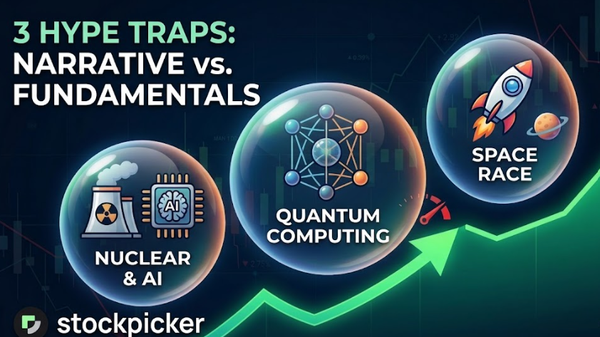
Every few years, a new investing narrative takes over the market. Ten years ago it was cannabis stocks, then green energy, then electric vehicles. The same hype cycle every time — investors poured money into unprofitable companies with projected total addressable markets of hundreds of billions. The results were always the same: the stock price skyrocketed, the fundamental metrics failed to grow, the bubble burst, and investors lost money.
Here are three narratives driving markets right now.
Nuclear Energy & AI Power Demand: Oklo (OKLO) vs. Vistra (VST)
AI models require massive computing power. Data centers require massive, stable power loads to run those models. The only reliable source of low-carbon baseload energy is nuclear power.
So far, it sounds compelling. But nuclear plants require years of development, construction, and regulatory approvals. Energy is also a commodity, which means we cannot expect high margins regardless of who wins the contracts.
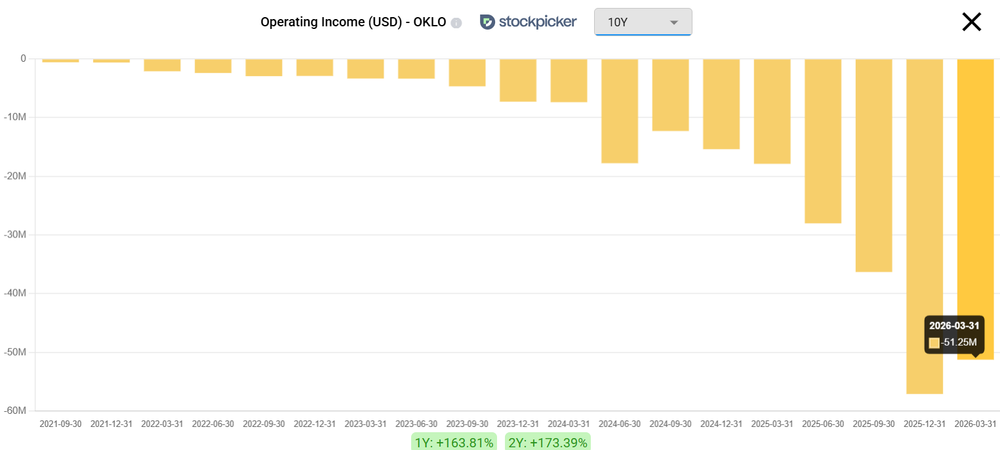
Oklo is one of the most commonly mentioned names. This is a pre-revenue company developing a small modular reactor with a target to generate revenue in two years. It may well succeed and benefit society. But what justified a stock price movement from $20-30 up to $190 per share? The company has a contract with Meta to supply 1.2 gigawatts of energy — but they still need government approval for their reactor design and then need to build the facilities. Today the stock is at $68 with an $11 billion market cap. Nothing in the fundamentals justifies that number. Investing in Oklo is a moonshot.
Vistra Corp is different — it actually produces energy and is considered the primary beneficiary of AI power demand. But here is what the revenue chart shows:
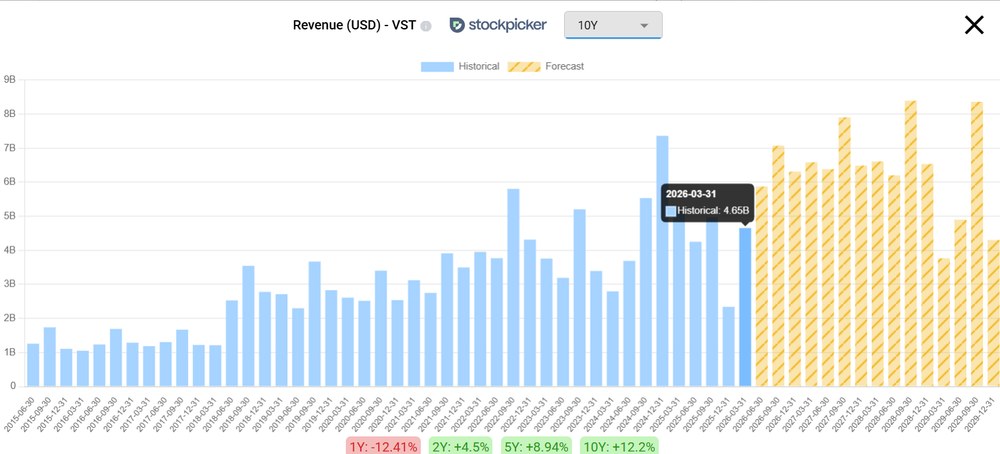
Vistra's revenue in Q1 2026 was $4.65 billion — down 12.41% year-over-year. The stock re-rated massively on the AI power demand narrative. The actual revenue moved in the opposite direction. The reason is straightforward: energy supply is not elastic. Building new power plants takes years. Vistra has signed large contracts with Meta and Amazon, but hyperscalers still need to build the data centers, and those contracts will take time to show up in the numbers. The forecast looks optimistic but those are analyst projections, not signed revenue. In the meantime, the stock is pricing in results that have not arrived yet.
VST Fundamentals analysis charts
The Quantum Computing R&D Hype: Rigetti (RGTI)
The narrative here is that quantum computers can solve problems ten thousand times faster than a modern supercomputer. That is true in theory. The problem is that we are still in the R&D phase and there is no commercial use for quantum computers yet.
Rigetti Computing is the clearest example. The stock moved between $10 and $58 over the last year. Market cap is $8 billion. Here is the revenue chart:
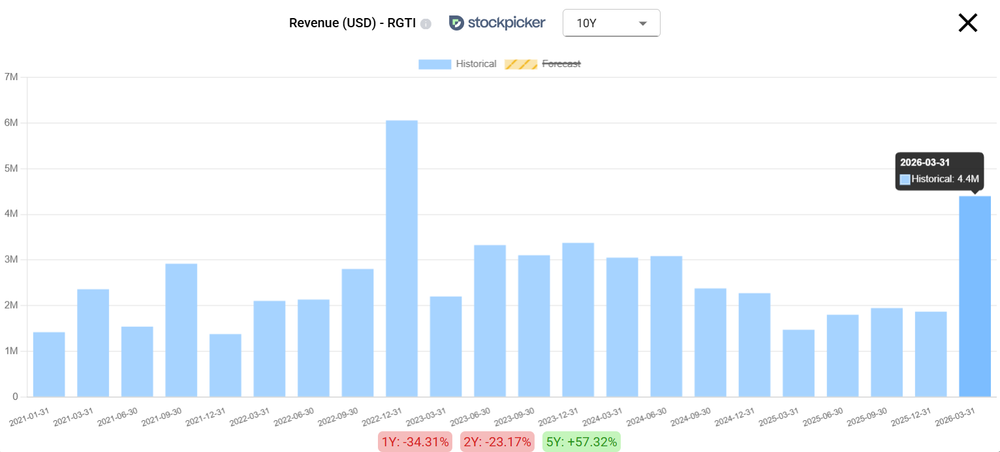
Revenue in Q1 2026 was $4.4 million. The revenue has been bouncing between $1 million and $6 million per quarter for five years with no clear growth trend. That is the revenue of an early-stage startup, not a $8 billion company.
Now look at what is actually growing(operating loss):
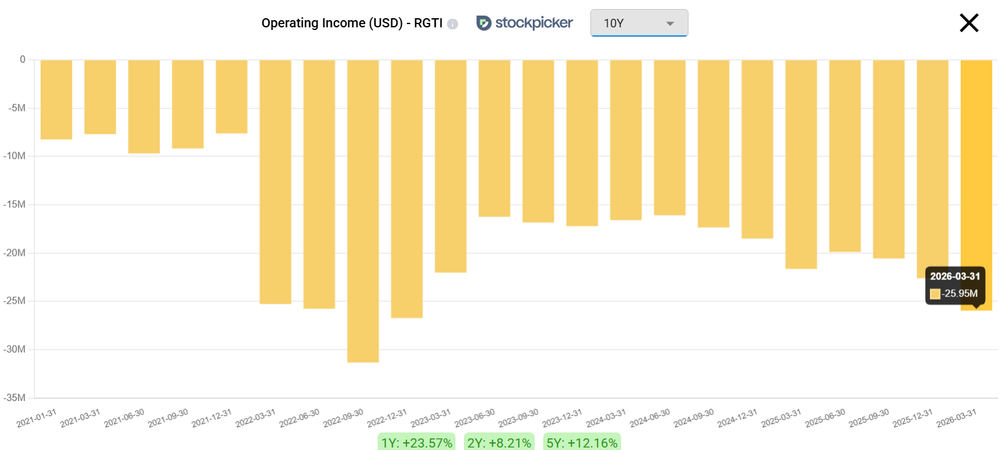
Every single bar is below zero. Operating loss in Q1 2026 was $25.95 million. The company is burning six times more cash in operating losses than it generates in revenue, every quarter. This is a high-beta stocks that moves 50% up or down overnight on a single headline, with no fundamental anchor.
There is also the competitive reality. Google, Microsoft, and IBM are all developing quantum computers with significantly more capital than any quantum startup. If a breakthrough happens, the hyperscalers are better positioned to monetize it.
The Multi-Trillion Dollar Space Race: SpaceX S-1 and Rocket Lab (RKLB)
The narrative exploded around the expected IPO of SpaceX, which is being priced at over $1.5 trillion market cap. SpaceX generated $18.7 billion in revenue in 2025 and lost money. Q1 2026 revenue was $4.6 billion with an operating loss of $1.9 billion.
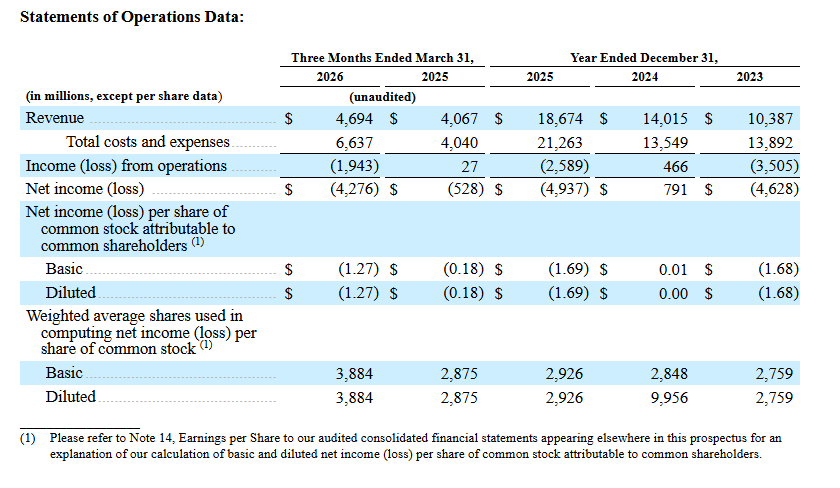
Source: SpaceX S-1 Filling
To justify a $1.5 trillion valuation on $4 billion in quarterly revenue from an unprofitable company, their S-1 filing states a total addressable market of $28.5 trillion. The reasoning is that SpaceX will "extend the light of consciousness to the stars." This phrase was written 7 times in the S-1 filling.
This is not a moonshot. It is a Mars shot. And the concerning part is that SpaceX will likely be included in the NASDAQ 100 and S&P 500, meaning retirement funds and passive ETF investors will automatically become shareholders at this valuation whether they choose to or not.
Rocket Lab tells a similar story. The stock was up 440% over the trailing 12 months at an $85 billion market cap. The revenue chart:
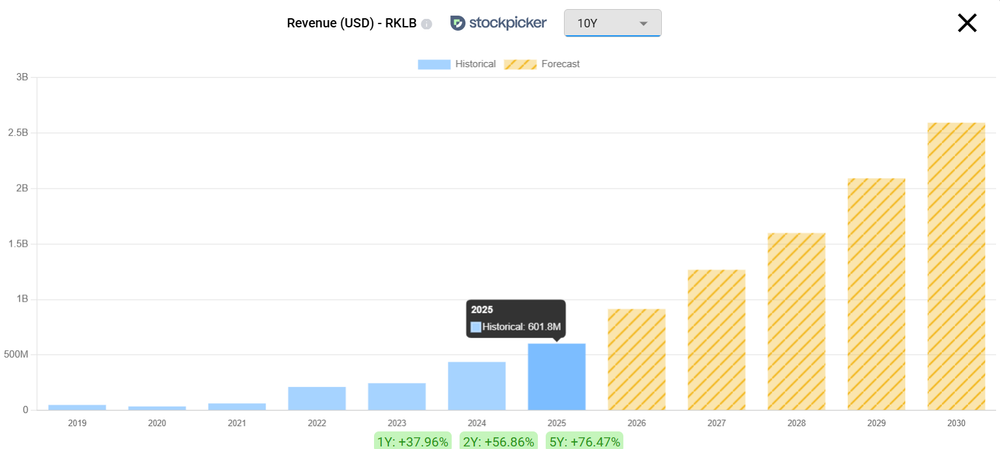
Revenue is genuinely growing. $601.8 million in 2025, up 38% year-over-year. The forecast projects $2.5 billion by 2030, which would be strong growth if they hit it. This is seems like a legitimate growing business.
The problem is what you are paying for it:
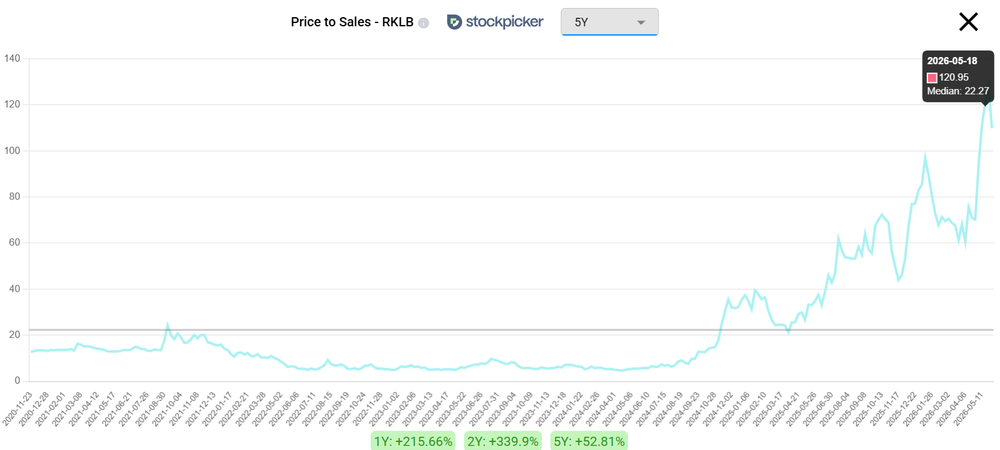
The historical median price-to-sales ratio for Rocket Lab is 22x. It is currently trading at 121x. That is 5.4 times the historical median. For context, the P/S sat flat between 5x and 10x for most of 2021-2024. It only exploded in 2025 when the space narrative took off. The revenue growth is real. The valuation has already priced in years of perfect execution — and then some more.
Then there is the dilution:
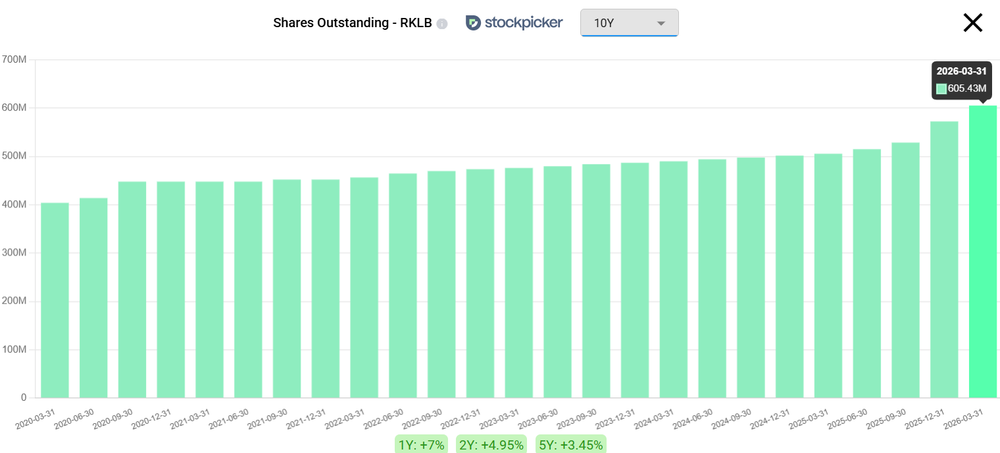
Rocket Lab grew from 404 million to 605 million shares outstanding over the last five years. That is 50% dilution. And notice the slope of the last two bars: the pace is accelerating. As the stock price rose, management issued more shares. Every year you hold this company, you own a smaller percentage of it.
Rocket Lab fundamental analysis
The Pattern
I am not saying investors cannot make money trading these narratives. Some will. But the price action is driven by headlines, not fundamentals. In these situations, someone usually ends up holding the bag.
I prefer companies where the "bag holders" are not other investors, but happy consumers who spend money with the business every day.
For fundamental charts on any of these companies: https://stockpicker.tech/