AST SpaceMobile (ASTS) Burned $500 Million Last Year to Connect 3 Billion Phones from Space
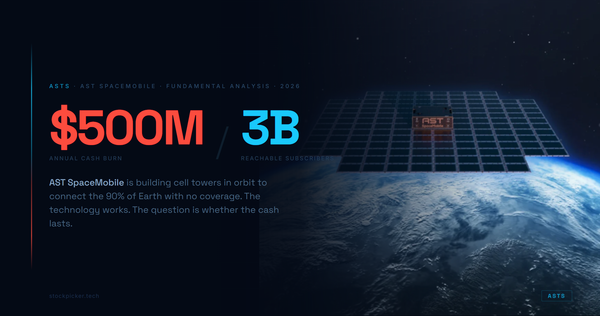
The moment you step outside a major city, you are effectively offline. Cell towers cover only about 10% of the Earth's surface, and AST SpaceMobile built a solution to fix that.
ASTS is a space telecom company that sends data at speeds of 100 megabits per second straight from space. Next time you are hiking, you can video call your family from the summit without extra hardware. It works with the phone you already have.
- Core Product: Satellite broadband that connects to any existing smartphone,
no extra hardware required - Scale: $1.2B in commercial contracts; 45+ carrier partners including AT&T,
Verizon, and Vodafone; access to 3B+ existing subscribers - Execution Risk: 10 satellites in orbit today; needs 45 for meaningful
commercial coverage; Q1 revenue missed estimates by 61% - Burn Rate: $500M/year cash burn; $3B cash on hand; shares outstanding
grew 140%+ since Q1 2024
How AST SpaceMobile Splits Revenue with AT&T, Verizon, and 45 Other Carriers
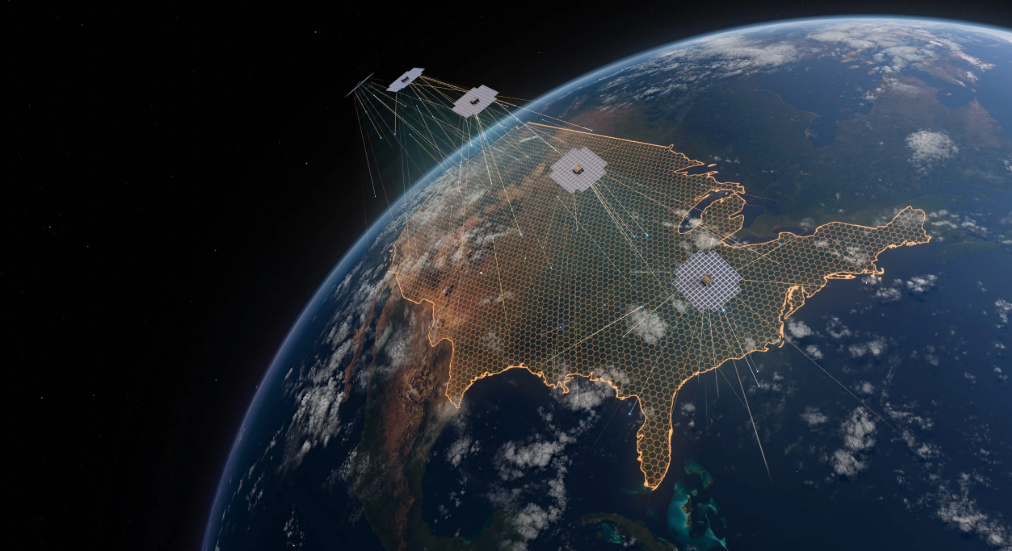
They do this by launching massive satellites 500 kilometers into orbit to act as cell towers in space. When your phone enters a dead zone, it connects to the nearest satellite the same way it switches between ground towers when you drive.
AST Spacemobile is not trying to replace traditional telecoms. They fill the coverage gaps the carriers cannot reach profitably and split the revenue with them, which is why the model has already secured $1.2 billion in commercial contracts.
AT&T and Verizon have both signed on (two companies that compete on almost everything and share almost nothing). Alongside Vodafone, Rakuten, and 45 other global carriers, AST now has direct access to over three billion existing mobile subscribers. Rakuten has since moved beyond a carrier agreement into a full joint venture with ASTS to offer satellite connectivity in Japan.
Why AST SpaceMobile Can Reach Smartphones That Starlink Cannot
Starlink requires a $300 dish and a separate subscription. It does not work with the phone you already own. More recently they started offering direct-to-device connectivity through a T-Mobile partnership, but their satellites were never designed for this. Their antennas are too small to deliver a stable connection to a standard smartphone.
Today with Starlink direct-to-device, you can send a text from a mountain summit.
With ASTS, you can stream a Netflix movie from that same mountain.
ASTS Bluebird satellites carry antennas roughly the size of a basketball court, among the largest commercial antennas ever launched. That is what allows them to reach the weak signal from a smartphone 500 kilometers below and return real broadband speeds. The latest BlueBird satellite recorded a peak download speed of 98.9 megabits per second, faster than most home WiFi connections.
Starlink's next-generation V3 satellites are designed to close this gap, but V3 requires the Starship rocket, which is not yet reliably operational, so ASTS currently has a technical lead of several years.
In early 2026, the Space Development Agency awarded AST Spacemobile a $30 million contract to test the BlueBird constellation for military tactical communications. When the Department of Defense is running live tactical tests on your satellites, that is a reasonable signal that the technology does what it claims.
How Many BlueBird Satellites Does AST SpaceMobile Have in Orbit Right Now
On June 17th, AST launched BlueBird 8, 9, and 10 on a Falcon 9 rocket, bringing the network to 10 satellites in orbit. These three satellites nearly double the peak data speeds of the previous generation.
They have scheduled BlueBird 11, 12, and 13 for the first half of August, which would bring the constellation to 13 satellites in orbit.
The target for 2026 is 45 satellites, which is the minimum needed for meaningful commercial coverage across North America, Europe, and Japan. At 90 satellites the constellation achieves 24/7 global coverage.
Will AST SpaceMobile Have Enough Cash to Complete the BlueBird Constellation
Their original plan from 2020 had the full constellation operational by 2024. They are now two years behind that schedule and still need 35 more satellites just to reach this year's target.
Satellite launches depend on weather, rocket availability, component supply chains, and regulatory approvals, none of which AST fully controls. The full-year revenue guidance is heavily back-loaded toward Q3 and Q4, and those quarters only deliver if the launches stay on schedule. If they do not reach meaningful coverage, telecoms will not offer the service at scale. Every day of delay moves the revenue projection further out and increases pressure on the cash position.
What AST SpaceMobile Q1 2026 Earnings Reveal About the Cash Burn and Dilution Risk
Revenue guidance for 2026 is $150 to $200 million, more than double their 2025 revenue. Q1 came in at $14.7 million against expectations of $37.5 million, a 61% miss.
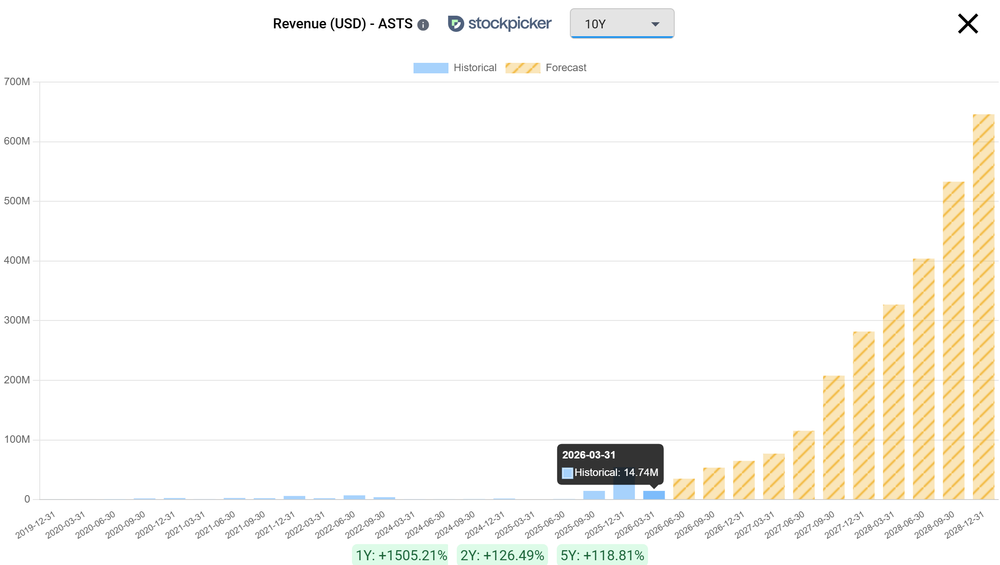
The more pressing numbers are the losses and the cash burn. ASTS posted a $191 million net loss in a single quarter and the trailing twelve-month net loss is over $500 million and growing. The market cap of nearly $30b is pricing great execution.
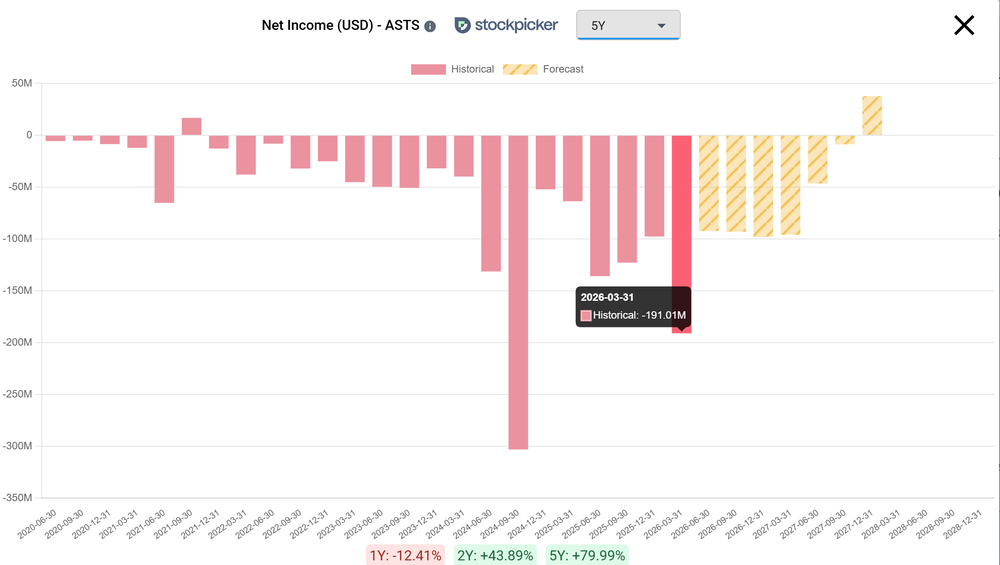
Each BlueBird satellite costs roughly $20 million, so getting to 45 satellites costs hundreds of millions before the constellation generates meaningful revenue. The company ended Q1 with $3 billion in cash, but the burn is $500 million a year and rising. And 45 satellites is just the first milestone. Full global coverage requires 90 satellites by 2028, and they have regulatory approval for up to 248.
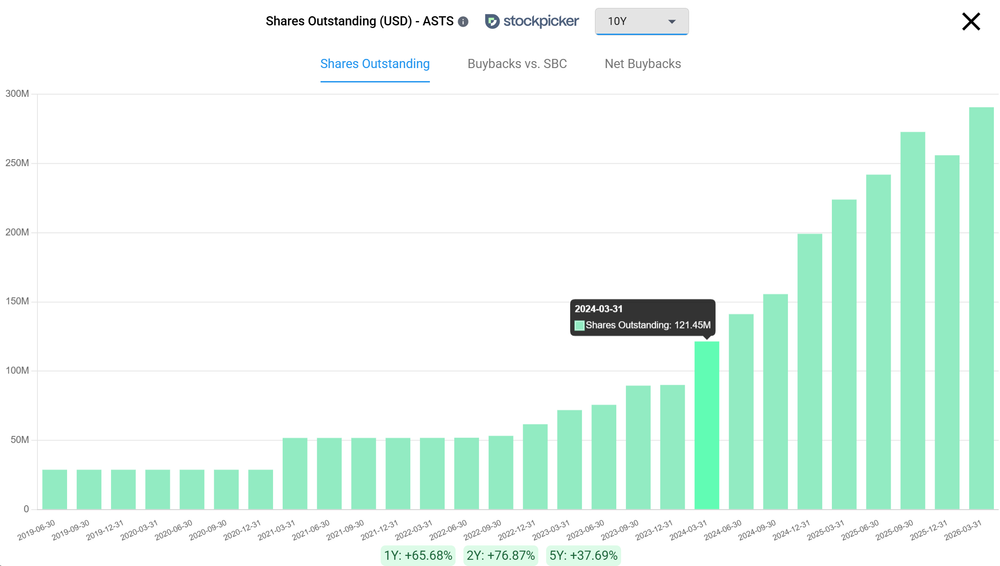
To fund all of this, AST has been issuing shares and convertible notes aggressively. Shares outstanding grew from 120 million in Q1 2024 to 290 million in Q1 2026, and the dilution may continue as long as the launches do.
The technology works and the partnerships are real, but there is no financial predictability right now. Every launch delay pushes the revenue timeline further out and puts more pressure on the cash position.
The stock moves on satellite launch news, not on earnings. This is not a position you size based on a financial model.
Starlink is the competitor I mentioned. If you want to know what their financials actually look like — and what the SpaceX valuation at $2.1 trillion is built on — that is the next read.
SpaceX: The Valuation Behind the IPO
For the fundamental charts: stockpicker.tech
Full disclosure: I do not currently hold a position in ASTS.
This post is for informational purposes only. I am not a licensed financial advisor and nothing here should be read as investment advice. Always do your own research before making any investment decision.